Shinichi Suzuki (1898-1998)
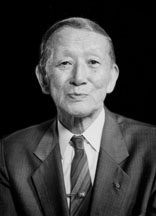
Violinist, educator, philosopher and humanitarian.
Founder of the Suzuki Method.
A Short Biography
Shinichi Suzuki spent his life proving that ability is not inborn and that talent can be created. Born in Nagoya, Japan on the 17th of October in 1898, he is remembered for his method of teaching young children so that all develop exceptional talent.
His father, Masakichi Suzuki, ran a workshop that made traditional Japanese stringed instruments. Fascinated with the violin, he made his first one in 1888, and by the early 1900's he owned the first violin factory in Japan, which was also the largest in the world. He intended for his son Shinichi to help run the family business. Shinichi Suzuki instead taught himself to play the violin, inspired by a recording of Mischa Elman playing Schubert's Ave Maria. A wealthy Japanese nobleman from the Tokugawa family became Suzuki's patron, first inviting him to Tokyo for lessons with Ko Ando, a former student of Joachim, and then bringing him to Berlin in 1921 for further study. Suzuki there became a student of Karl Klingler, another Joachim pupil.
While in Berlin, Suzuki was befriended by Albert Einstein. On one of many musical evenings he met his future wife, Waltraud Prange, a soprano. They married in 1928. Suzuki returned to Japan the next year and formed a string quartet with three of his brothers, touring the country to give concerts. In 1930 he became president of the Teikoku Music School and was conductor of the Tokyo String Orchestra.
At a quartet rehearsal one day in 1933 he surprised his brothers by suddenly stating what they considered obvious: that ALL Japanese children speak Japanese. With this simple observation, Shinichi Suzuki had discovered a way to develop musical ability in young children. Children can learn to play a musical instrument (or anything else) in the same way that they first learn language.
In 1946 Suzuki went to Matsumoto where he helped start a music school, eventually named the Talent Education Research Institute. In this remote city in the center of Japan, beneath an ancient castle and in the shadow of the massive and beautiful "Japan Alps" he continued to develop his method. By the 1960's, Western teachers had begun to travel there in order to see Suzuki's students and to learn from him. In 1964 the first Japanese Suzuki tour group performed in the USA for music educators, and in 1973 the tour group traveled in Europe.
Suzuki achieved much of what he did because of the support of his remarkable wife, Waltraud. She painstakingly prepared an English translation (from the Japanese) of his autobiography, Nurtured by Love, first published in 1969.
Suzuki's success was immediate and far-reaching. His first pupils, Toshiya Eto and Koji Toyoda, have achieved international renown. Many of today's soloists and members of the finest orchestras started their musical education as Suzuki students, as have a high proportion of students presently studying in music conservatories. Today there are over 8,000 trained Suzuki teachers and nearly a quarter of a million Suzuki pupils, worldwide.
Suzuki often spoke of nurturing the "life force," His was exemplary. He continued to be active as a teacher throughout the world until well into his nineties and died in his sleep at his home in Japan on the 26th of January in his 100th year. During his lifetime he received many honorary degrees, was also named a Living National Treasure by the Emperor of Japan, and was nominated for the Nobel Peace Prize.
—Enid Wood
See also:
TERI (Japan): Personal History of Shinichi Suzuki
European Suzuki Association: Dr. Shinichi Suzuki
Suzuki Association of the Americas: The Story of Shinichi Suzuki
Asia Region Suzuki Association: Dr. Suzuki & His Philosophy
 Find us on Facebook